 Picklefinance
 jars
Pickle Finance's Jars were strategy vaults that harvested rewards and reinvested them into more of the asset each Jar accepted. Depositors received pTokens representing their share. The protocol's June 2025 wind-down announcement asked users to withdraw Jar funds.
How Were Rewards Reinvested?
Each Jar specified its deposit asset, commonly a liquidity provider (LP) token representing a share in a pool. Documented strategies also covered lending and staking positions. The strategy collected rewards from its underlying protocol, exchanged them for more of the accepted asset and reinvested the proceeds.
The SushiSwap ALCX/ETH Jar accumulated ALCX/ETH LP tokens. Its rewards arrived as ALCX and SUSHI; the strategy sold all SUSHI and some ALCX for ETH before acquiring more LP tokens. The reward tokens and the asset accumulated by the Jar were therefore different.
pToken Balances and Harvest Timing
A pToken represented a share of the Jar. Reinvestment generally left the pToken count unchanged while increasing the underlying assets represented by that balance. The deposit exchange ratio also mattered: one pToken did not always correspond to one unit of the underlying asset.
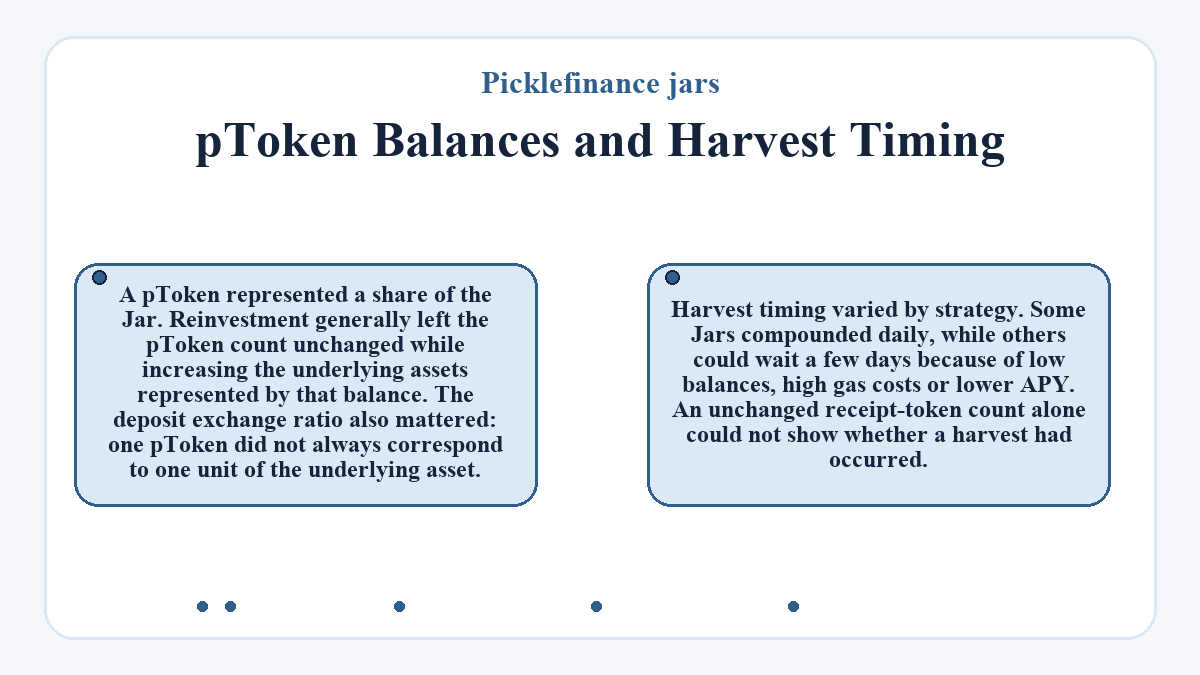
Harvest timing varied by strategy. Some Jars compounded daily, while others could wait a few days because of low balances, high gas costs or lower APY. An unchanged receipt-token count alone could not show whether a harvest had occurred.
Jar Yield and PICKLE Farm Rewards
Jar earnings accumulated in the accepted asset. Eligible pTokens could separately be staked in a matching Farm for PICKLE emissions. The documented Farm display combined applicable Jar returns, LP fees and PICKLE incentives, so its total APY did not describe a payment entirely in PICKLE. The DILL boost applied to that PICKLE incentive component.
Farm return estimates changed with emissions, the amount staked and token prices. They did not fix the amount that a position would earn over a year.
Asset Value and Contract Risk
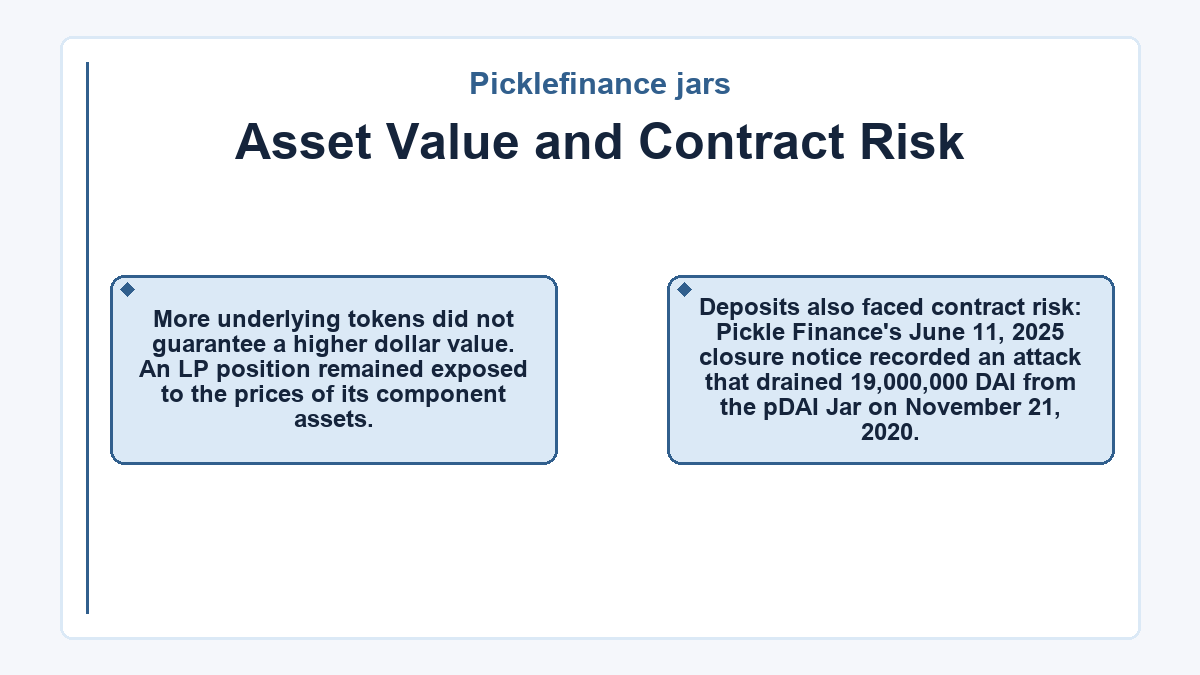
More underlying tokens did not guarantee a higher dollar value. An LP position remained exposed to the prices of its component assets. Deposits also faced contract risk: Pickle Finance's June 11, 2025 closure notice recorded an attack that drained 19,000,000 DAI from the pDAI Jar on November 21, 2020.
Jar Redemptions After the Wind-Down
Pickle Finance's Pickle Finance: Closing the Jar, published June 11, 2025, scheduled the frontend shutdown for October 1, 2025. It specified direct contract interaction for Jar withdrawals after that cutoff.
pTokens staked in a matching Farm had to be unstaked before Jar redemption. Redemption returned the Jar's underlying asset; for an LP Jar, a separate pool redemption was needed to receive the component tokens. Jar withdrawals were separate from the sunset treasury distribution.
Jar Position Checklist
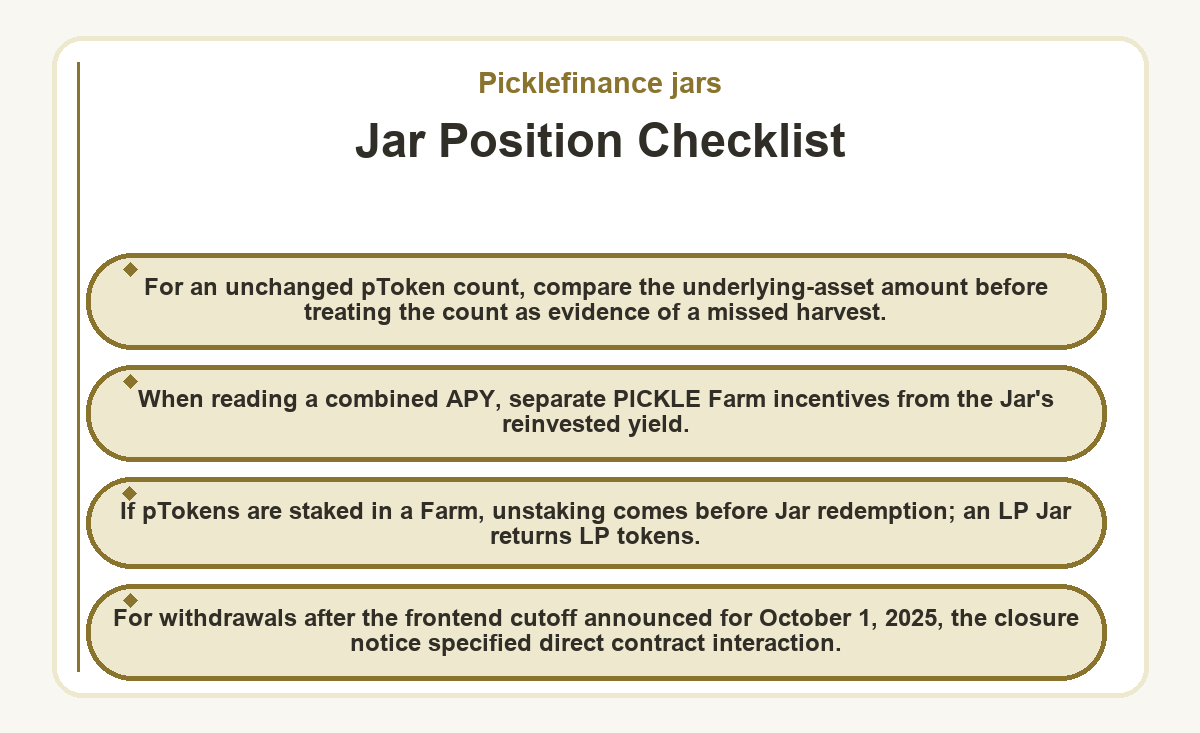
- For an unchanged pToken count, compare the underlying-asset amount before treating the count as evidence of a missed harvest.
- When reading a combined APY, separate PICKLE Farm incentives from the Jar's reinvested yield.
- If pTokens are staked in a Farm, unstaking comes before Jar redemption; an LP Jar returns LP tokens.
- For withdrawals after the frontend cutoff announced for October 1, 2025, the closure notice specified direct contract interaction.